Description
MUSE is officially an approved streaming venue for THE MET Opera: LIVE in HD! That’s right! You can experience the world of The MET Opera in your own neighborhood.
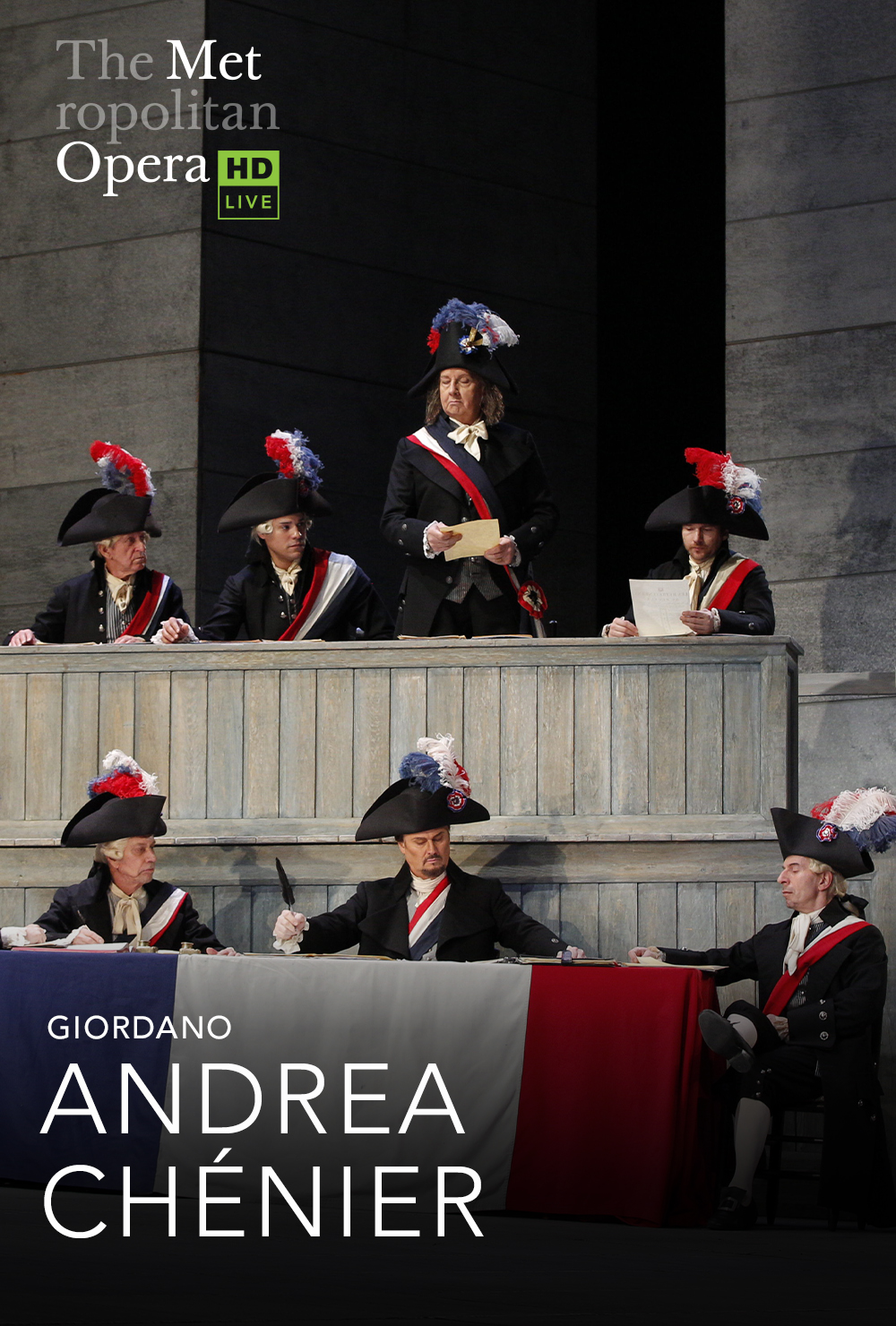
Giordano’s passionate tragedy stars tenor Piotr Beczała as the virtuous poet who falls victim to the intrigue and violence of the French Revolution, reuniting with soprano Sonya Yoncheva as Chénier’s aristocratic lover, Maddalena di Coigny. Daniele Rustioni takes the podium to lead Nicolas Joël’s gripping staging, which will be transmitted live from the Met stage to cinemas on December 13.
Following their celebrated partnerships in Giordano’s Fedora (2023) and Verdi’s Luisa Miller (2018), two of opera’s biggest stars, soprano Sonya Yoncheva and tenor Piotr Beczała, reunite to headline Giordano’s most popular masterpiece.
Daniele Rustioni, the Met’s newly named Principal Guest Conductor, conducts Andrea Chénier’s lush and stirring score.
Sung in: Italian
Synopsis
ACT I
Spring, 1789, at the Château de Coigny near Paris. Gérard, servant to the Countess de Coigny, mocks the aristocracy and their manners. Observing his father struggle with a piece of furniture, Gérard laments the suffering of all servants under their arrogant masters (“Son sessant’anni”). Maddalena, the Countess’s daughter, appears and Gérard realizes how much he loves her. Busy with preparations for a soirée that evening, the Countess scolds Maddalena for not yet being dressed. Maddalena complains to her servant, Bersi, about the discomfort of the current fashions and then runs out to change. Among the guests to arrive is Fléville, a novelist, who has brought with him the rising poet Andrea Chénier. After the Abbé relates the latest depressing news from Paris, Fléville enlivens the party with a pastorale he has written for the occasion. Maddalena then teases a reluctant Chénier into improvising a poem (“Un dì all’azzurro spazio”). Chénier scandalizes the guests with his criticism of the indifference of the clergy and the aristocracy to the suffering of the impoverished. The guests’ gavotte is interrupted by Gérard, who brings in a group of starving peasants. The Countess orders Gérard out along with the rabble. The guests are then invited to return to the gavotte, but they depart instead, and the Countess is left alone.
ACT II
Spring, 1794, along the Cours-la-Reine in Paris. The Revolution has begun, and the Reign of Terror is in full force. To fend off the Incredibile, a spy, Bersi pretends to be a daughter of the Revolution (“Temer? Perchè?”). The Incredibile is not deceived and notices that Chénier is waiting for someone in the Café Hottot. Chénier is joined by his friend Roucher, who has brought a passport so that Chénier may leave the country safely. Chénier says his destiny is to remain to find the love he has never had and to discover who has been writing him anonymous letters (“Credo a una possanza arcana”). A procession of dignitaries led by Gérard interrupts their conversation. The Incredibile takes Gérard aside to ask about the woman he is looking for. Gérard describes Maddalena to him. Meanwhile, Bersi asks Chénier to wait at the café for someone who wants to meet him. Maddalena appears and reveals to Chénier that it was she who wrote the letters. They pledge to love each other until death (“Ora soave”). The Incredibile, having seen Chénier and Maddalena together, brings Gérard to the scene. Gérard is wounded as Chénier defends Maddalena. Gérard, however, recognizes Chénier and sends him away, asking him to protect Maddalena. When the gathering crowd asks who wounded Gérard, he answers that his assailant was unknown.
ACT III
July 24, 1794, in the courtroom of the Revolutionary Tribunal. Mathieu, a revolutionary, is unsuccessfully urging the crowd to donate to the cause. Gérard, recovered from his wound, makes an impassioned plea for the motherland. Madelon, an old woman who has already lost her son and a grandson in the war, offers her last grandson as a soldier (“Son la vecchia Madelon”). As the crowd disperses, the Incredibile appears. If Gérard wants to have Maddalena, the Incredibile insists, he must first arrest her lover, Chénier. As Gérard writes the accusation, he is filled with remorse at the bloodshed he has caused in his rise to power. He concedes that his new master is passion (“Nemico della patria”). No sooner does he hand Chénier’s indictment to the court clerk than Maddalena appears. Gérard admits that he has laid a trap for her and that he loves her. Maddalena offers herself to Gérard if he will save Chénier. She has been a fugitive, her mother was killed in the Revolution and their home was burned (“La mamma morta”). Touched by her love for Chénier, Gérard promises to try to save him. The Tribunal convenes with an unruly mob in attendance. Chénier pleads for his life (“Sì, fui soldato”) and Gérard admits to the judges that the accusation he wrote was false. Nevertheless, Chénier is sentenced to death and taken away.
ACT IV
July 25, 1794, in the ruins of Paris’ St. Lazare prison. Chénier reads a final poem (“Come un bel dì di maggio”) to his friend Roucher, who then bids him a final farewell. Gérard and Maddalena are met by the jailer, Schmidt, whom Maddalena bribes with some jewels to allow her to take the place of another young woman sentenced to death. Gérard leaves to once again plead Chénier’s case with Robespierre. Maddalena tells Chénier she is there to die with him. As the day dawns, they share one final moment together (“Vicino a te”) before being taken to the guillotine.
Creators
Composer Umberto Giordano (1867–1948) was born in southern Italy and studied in Naples. Andrea Chénier was his first success, followed swiftly by the fervent melodrama Fedora. Luigi Illica (1857–1919), the opera’s librettist, was a colorful poet who had also written the text for Catalani’s La Wally, though his greatest fame would rest on his collaborations with Giacomo Puccini, including for La Bohème and Tosca.
Production: Nicolas Joël
Set and Costume Designer: Hubert Monloup
Lighting Designer: Duane Schuler
C. Graham Berwind, III Chorus Director: Tilman Michael